
Bureau Veritas Consumer Products Services
Report (6624)137-1288, 11 June 2024.
Meets AS/NZS 2172:2013 and the Consumer Product Safety Standard for children's household cots.
A cot is the one thing you buy where looking good isn't enough. Your baby will spend more than 20,000 hours in it, mostly while you're asleep in another room.
The first thing we spent money on when we started Bold Baby wasn't timber, or tooling, or a designer. It was a copy of the Australian cot safety standard AS/NZS 2172:2013. We read it cover to cover before we drew a single line.
Every dimension in this cot was set by that document before we made one decision about how it should look - the spacing between the bars, the depth of the sides, the height of the mattress base, the radius on every edge. Millimetres, all of them non-negotiable. The colour, the panels, the whole idea of a cot you can restyle: that was always the idea but it came afterwards, and it had to fit around the safety requirements rather than the other way round.
So rather than tell you it's safe and leave it at that, this page sets out how the Bold Baby Cot has been tested, by whom – Bureau Veritas, Intertek, the Australian Government's National Measurement Institute and Furntech-AFRDI, and against which standards - with the report numbers, so you can check rather than take our word for it.
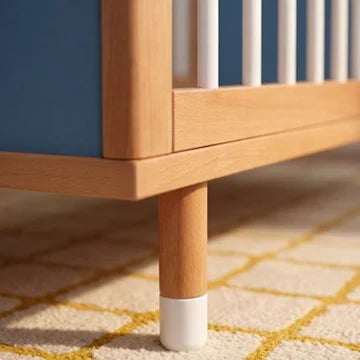
AS/NZS 2172:2013 - the one that governs how a cot is built, spaced and how much force it has to take. That's the standard that matters. Tested by Bureau Veritas, report (6624)137-1288.
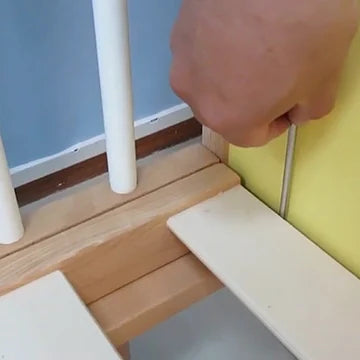
Bureau Veritas, Intertek, the National Measurement Institute and Furntech-AFRDI. Report numbers and dates are below.
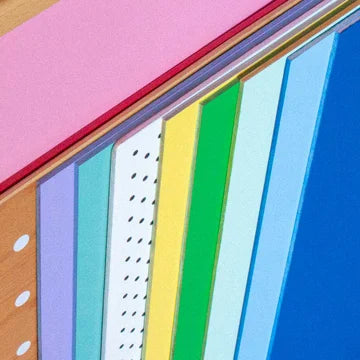
Every colour and printed panel was tested for the eight heavy metals regulated in children's products. None were detected in any sample.
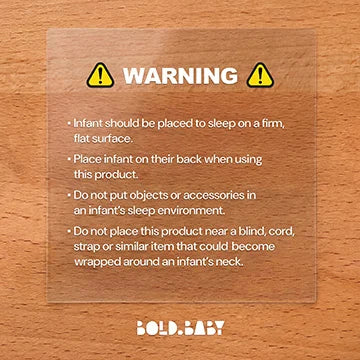
How the cot is built, and what mandatory warnings have to be written on it, in the booklet and supplied with it.
That's the whole picture. If you'd like to check any of it, every
laboratory, report number and date is set out below.
The Bold Baby Cot passed every applicable requirement of AS/NZS 2172:2013 – Cots for household use in testing by Bureau Veritas: entrapment hazard, impact, filler bar and corner post strength, stability, torque and tension tests, plus dimensional, foothold, snag-point and sharp-edge requirements.
Report (6624)137-1288, 11 June 2024.
Meets AS/NZS 2172:2013 and the Consumer Product Safety Standard for children's household cots.
Report (6623)004-0860, 14 March 2023.
Pass on all three requested standards.
Every paint colour, coating, panel and adhesive used in the cot has been tested for the eight toxic elements regulated under AS/NZS ISO 8124.3 – arsenic, barium, cadmium, chromium, mercury, lead, antimony and selenium. Across every test the result was the same: not detected, or below detection limits. Well under the allowable thresholds.
Report RN1492760, 2 April 2026, NATA no. 198.
Printed art panel inks in cyan, magenta, yellow, black, white and matte laminate. All eight elements below the 2.5 mg/kg detection limit. Accredited to ISO/IEC 17025.
Report (6625)336-0070, 5 December 2025.
All six colourway paints tested to AS/NZS ISO 8124.3:2021 + A1:2023. Pass, all elements not detected.
Report TSNH00484882, 2 February 2024.
Assembly adhesive and varnish tested to AS/NZS 8124.3:2012+A1:2016. Pass, all elements below detection.
From 19 January 2026, suppliers of household cots in Australia must comply with two new mandatory standards, introduced on 18 July 2024. Both parts were tested by independent laboratories: Bureau Veritas for the safety standard, Furntech-AFRDI for the information standard.
The Consumer Goods (Infant Sleep Products) Safety Standard 2024, as amended in February 2025, sets design, construction, performance and testing requirements. For household cots it requires the cot to meet one of three recognised standards: AS/NZS 2172:2013, ASTM F1169-19, or BS EN 716-1:2017. The Bold Baby Cot complies via AS/NZS 2172:2013, passing every applicable requirement in independent testing at Bureau Veritas.
The Consumer Goods (Infant Products) Information Standard 2024 governs the warnings marked on the cot itself and the safe-use information supplied with it. This is a separate requirement from structural safety. In January 2026 the cot was tested against this standard at Furntech-AFRDI.
Furntech-AFRDI, Australasian Furnishing Research & Development Institute - Test Report 18347-1, 29 January 2026. Tested to the requirements of the Consumer Goods (Infant Products) Information Standard 2024. Every assessed requirement was recorded as compliant - safe-use and assembly information, recommended mattress dimensions, height-adjustment instructions, country-of-origin and importer markings, and the permanent safe-sleep warnings on the product and its packaging.
Two notes on scope, for completeness. Section 10 of that standard covers warnings displayed online and in store; it was not part of this test, because those requirements sit with us and our retailers at the point of sale rather than with the product itself. And as is standard for all testing laboratories, Furntech-AFRDI assesses samples against published criteria - it does not issue brand endorsements, and nothing on this page should be read as claiming otherwise.
Sources:
ACCC Product Safety - Household cots mandatory standard; ACCC Product Safety - Infant sleep products mandatory standards; Consumer Goods (Infant Sleep Products) Safety Standard 2024; Consumer Goods (Infant Products) Information Standard 2024. Information current as at August 2026.
Testing tells you one sample passed. It doesn't tell you the 100th cot off the line is the same as the first. So we built our own quality checks on top of it.
Before any production run ships, our manufacturer photographs and films every individual component with its measurements shown. Those images come to us and we cross-check each one against the plans and specifications the standard set. Where anything looks marginal, we measure it ourselves. Bar spacing, panel thickness, base height, side-rails, spindles, the radius on a corner – if anything isn't within an accepted tolerance, it doesn't pass.

Every component is photographed with its measurements in frame, then checked against specification before a production run ships.
Before a production run ships, Jim flies out to our manufacturer and spends the time on the line, inspecting parts by hand as they come off it — thousands of pieces, one at a time.
It isn't the fastest way to run quality control. But we put our name on something babies sleep in, and we want to have held it before you do.

Jim at the factory, checking components as they come off the line.
For safe sleep guidance, visit Red Nose Australia or Healthdirect.
Yes. It was tested by Bureau Veritas and meets AS/NZS 2172:2013 (report (6624)137-1288, June 2024), along with the mandatory Australian consumer product safety standard for household cots.
Four independent laboratories. Bureau Veritas carries out our structural and chemical testing, the Australian Government's National Measurement Institute tests our printed panel inks, and Intertek tests our adhesives. Separately, Furntech-AFRDI tested our labelling and product information against the 2024 Information Standard.
Yes. Every colourway and printed panel has been tested for the eight regulated toxic elements. Results: not detected in all samples, including Australian Government NMI testing in 2026.
A standard Australian cot mattress, 1320 × 700 mm, maximum 110 mm thick. No proprietary or brand-specific mattress is needed.
Yes. The structural requirements are met via AS/NZS 2172:2013, tested by Bureau Veritas. The labelling and information requirements were tested at Furntech-AFRDI in January 2026, report 18347-1.
Start with our Declaration of Conformity (PDF) – a single document listing every standard the cot meets, with the laboratory, report number and date behind each one.
The full test reports contain commercial and personal information so we don't circulate them publicly, but every claim on this page can be traced back to a specific document. If you have a question about the testing, email support@bold.baby and we'll be happy to help. Retailers, buyers and regulators can request our full compliance file.
